How much can be told through a single still? What is the story that is being told?
Infinite.
Is this the beginning of a greater story of this child's life? Is this the end of a tragedy that has a positive ending? Why is the toddler sitting down? Why is he looking up? Is it early or late fall? What part of the county is he or she in? There is no correct interpretation of what any one picture means but a million different things can be said.
Communication is not all about a dialogue, monologue, or words in general. Those are three very important parts of communication but having a different perspective on what things mean creates a unique experience with every moment of everyone's life.
Connections to images are unique to each person and can reveal a lot about a person, but what is their story and why does it contribute to their interpretation? A Rorschach test or an ink blot test is often used to explore the deeper meaning behind what someone is thinking. A patient's response to the ink blots on a paper reveal their story like an interpretation of a picture.
Photographers also take on the responsibility of telling a story when they publish a photo. There is an experience behind every photo and it allows for a greater creation than just pixels on a piece of paper.
Without story tellers, communication would be nearly impossible because there would be no common stories to tie together the individual stories of each person or each photo. Pictures give us that common story and adds to our knowledge of the greater world.
Monday, February 15, 2016
Sunday, February 7, 2016
Everybody Lies
Lying is a normal part of being human. Whether it's to keep someone's feelings from being hurt, or trying to get oneself out of a bad situation, or it's simply to keep a secret, everybody lies. It's hard to strike a balance between an appropriate amount of lying and being honest which, as Billy Joel puts it "Honesty is such a lonely word./Everyone is so untrue./Honesty is hardly ever heard./And mostly what I need from you."
Truthfulness and honesty is what is craved in the modern day and age, but that's not what people really want. Everyone wants to be told they're the best thing to happen since sliced bread, which in fact, no one is. And while that is incredibly harsh, I'm just being honest and isn't that what everyone wants?
No. Of course not.
Honesty is not always the best policy. White lies are more and more accepted in today's day and age, and really, they're harmless. Telling someone they look good in a new outfit, saying that will boost his or her confidence to really look good in that outfit. Half of looking good is having the confidence to think that you actually look good.
Honesty is the best choice most of the time, but honesty is help up to be this great thing we should all strive for. The only person we need to be completely honest with is our self. And that means not putting yourself down and not building yourself up more than you are.
Everyone lies. It's part of what makes us human. As humans, we also love to hear lies because they are much more interesting than the truth.
Spreading a lie is much easier than spreading the truth. Lies are interesting and fun, whereas the truth can be humbling and hard to deal with. The brain shuts down in response to traumatic to read more about the effects of trauma on the brain click here. It shrinks the frontal cortex (where we make our decisions) to make room for a larger amygdala which stimulates the fight or flight response in the nervous system. Have more aggressive tendencies with fewer neurons to make decisions isn't the type of person that woud thrive in modern society. So as an evolutionary feature we forget the experience and try to function the way society wants us to.
It's a fine line to walk. Lying and telling the truth. However, lying isn't as sinful as perceived by society, but constantly lying isn't the answer either.
Truthfulness and honesty is what is craved in the modern day and age, but that's not what people really want. Everyone wants to be told they're the best thing to happen since sliced bread, which in fact, no one is. And while that is incredibly harsh, I'm just being honest and isn't that what everyone wants?
No. Of course not.
Honesty is not always the best policy. White lies are more and more accepted in today's day and age, and really, they're harmless. Telling someone they look good in a new outfit, saying that will boost his or her confidence to really look good in that outfit. Half of looking good is having the confidence to think that you actually look good.
Honesty is the best choice most of the time, but honesty is help up to be this great thing we should all strive for. The only person we need to be completely honest with is our self. And that means not putting yourself down and not building yourself up more than you are.
Everyone lies. It's part of what makes us human. As humans, we also love to hear lies because they are much more interesting than the truth.
Spreading a lie is much easier than spreading the truth. Lies are interesting and fun, whereas the truth can be humbling and hard to deal with. The brain shuts down in response to traumatic to read more about the effects of trauma on the brain click here. It shrinks the frontal cortex (where we make our decisions) to make room for a larger amygdala which stimulates the fight or flight response in the nervous system. Have more aggressive tendencies with fewer neurons to make decisions isn't the type of person that woud thrive in modern society. So as an evolutionary feature we forget the experience and try to function the way society wants us to.
It's a fine line to walk. Lying and telling the truth. However, lying isn't as sinful as perceived by society, but constantly lying isn't the answer either.
Monday, January 11, 2016
Cellphones
Ring Ring. It's your cellphone. Well, actually, nowadays it's more of a ding ding. I can't remember the last time I called someone just to talk to them without making sure they were available over text first.
As a woman, extrovert, and quick thinker I prefer a phone call to texting but I can't call someone for ten minutes between my classes every time I want to talk to him/her. So I shoot a quick text and the conversation we're having continues. Planning is also very convenient over text because people can respond when they have time, rather than playing phone tag all day.
Nancy O'Neill published a blog on Why People Text Instead of Talk
In this blog she goes over several reasons (very unscientific) about why people text rather than talk. One reason that stood out to me (as a communication blogger) was that some people prefer texting because they want to have a conversation that last over several hours.
While I hardly ever talk on the phone for more than five minutes at a time, I do see the advantage in having that constant contact with another person for a long period of time. That being said, that person is not getting your full attention for any one minute of those several hours. Send a quick text, continue what you were doing and ten minutes later check your phone and respond to another text. It's part of our common activities.
However according to Elliot Slenk's blog titled Texting or Calling the heavy texters (50 or more a day) are also heavy on phone calls, It comes from being on phones all the time and wanting to talk to people.
Through texting, there are so many more chances for the meaning of words or sentences to be misunderstood and lead to friction between the sender and receiver. Texting does allow for more time to think though which can help eliminate any quick comments that should not be said out loud.
As a seventeen year old girl, I am never without my cellphone. It often sits on the table during class and it is always in my hand during passing periods. I use my phone for everything. Planning, texting, sharing pictures, calling, playing candy crush, surfing the web and even my countdown until graduation. There is truly an app for everything and I take total advantage of that. I love having all the information in the world at my fingertips. That's not something anyone could've even dreamed of 50 years ago. That's what is so truly amazing.
Cellphone bridge the gap between two people far apart from each other, but puts up a wall with those who we have in real life. It's important to balance out communication in the digital world and communication in the real world.
Thursday, January 7, 2016
Book Review: Unwind
The following is a review of the book Unwind by Neil Schusterman. For the Wikipedia article on this book click here.
This book is about a alternate society to our own where children are unwound. Unwound means being taken apart and used in hospitals as if an organ donor, but by choice of their parents. It's a story mainly focused around four runaways from being "harvested". The story has lots of twists and turns, eventually leading to a very detailed description of an unwinding.
The story within itself is a comment on what I assume is slavery. These children are trapped into this fate by their parents. In Conor's case, his parent believe that he's gotten in too many fights, Risa is a ward of the state and no longer able to stay in the system because of budget cuts. Remember being unwound means one is literally taken apart and used to supplement other people who need treatment in hospitals.
A very interesting part of the novel is Lev, a very religious character that is being unwound because his parents believe that 10% of everything they own should be donated to the church, including children. Lev happens to be the tenth child and because he has been told he was going to be unwound from birth he is very committed to go to the harvesting camp.
The characters also find themselves in a system very similar to the underground railroad, which hides kids that have gone AWOL. There is a movement against unwinding, just as though there was a movement against slavery.
Schusterman communicates a very compelling story full of adventure and an obviously distopian world. It is an incredible book with lots to offer for the world of communication and telling the story about slavery through this book. It is well written but at a reading level for most middle school students. The pull of an alternate world is just too strong in recent years, but "Unwind" sent itself apart from all the others.
4.8 stars.
This book is about a alternate society to our own where children are unwound. Unwound means being taken apart and used in hospitals as if an organ donor, but by choice of their parents. It's a story mainly focused around four runaways from being "harvested". The story has lots of twists and turns, eventually leading to a very detailed description of an unwinding.
The story within itself is a comment on what I assume is slavery. These children are trapped into this fate by their parents. In Conor's case, his parent believe that he's gotten in too many fights, Risa is a ward of the state and no longer able to stay in the system because of budget cuts. Remember being unwound means one is literally taken apart and used to supplement other people who need treatment in hospitals.
A very interesting part of the novel is Lev, a very religious character that is being unwound because his parents believe that 10% of everything they own should be donated to the church, including children. Lev happens to be the tenth child and because he has been told he was going to be unwound from birth he is very committed to go to the harvesting camp.
The characters also find themselves in a system very similar to the underground railroad, which hides kids that have gone AWOL. There is a movement against unwinding, just as though there was a movement against slavery.
Schusterman communicates a very compelling story full of adventure and an obviously distopian world. It is an incredible book with lots to offer for the world of communication and telling the story about slavery through this book. It is well written but at a reading level for most middle school students. The pull of an alternate world is just too strong in recent years, but "Unwind" sent itself apart from all the others.
4.8 stars.
Tuesday, December 15, 2015
Non-verbal Communication
There are four major communication skills. Listening, thinking, nonverbal, and speaking. I've focused a lot on the speaking aspect recently, with a brief detour for maps and their influence over the world today.
I want to focus on the nonverbal aspect of communication today. Body language, facial expressions, and gestures all have a very important role to play in how we communicate with other people around us.
Body language conveys a lot about what a person is feeling, even if it's not entirely true. Look at the four women in this photo. While they are all the same woman, each position comes across as a very different emotion. This woman appears to be getting ready for an interview, and as this picture came from an article titled: 7 Body Language Mistakes May be Holding Back Your Career, I think it's safe to say that's what she's doing. The first woman looks bored out of her mind, and doesn't seem to really want the job. The second women's mind seems to be elsewhere and waiting for the weekend or dinner with friends after the interview. The third woman seems far too relaxed for an interview giving out a bad vibe for potential employers. The fourth women looks to be eager to interview, but confident enough to hold her ground. She seems very prepared with her papers in hand and a friendly, welcoming smile on her face. Out of these four women I would hire the woman on the far right because she has the right body language.
Nonverbal communication is not only important for interviews, but for everyday communication. Facial expressions, for example, show what a person is thinking/feeling at any given moment. No sound is needed for me to know that the second row far right picture is disgusted with whatever is happening in front of her. Facial expressions change the way words come across to a listener and can alter the tone of what is being said. What they say is true, "it's not what you say, but how you say it" and facial expressions are a big part of that.
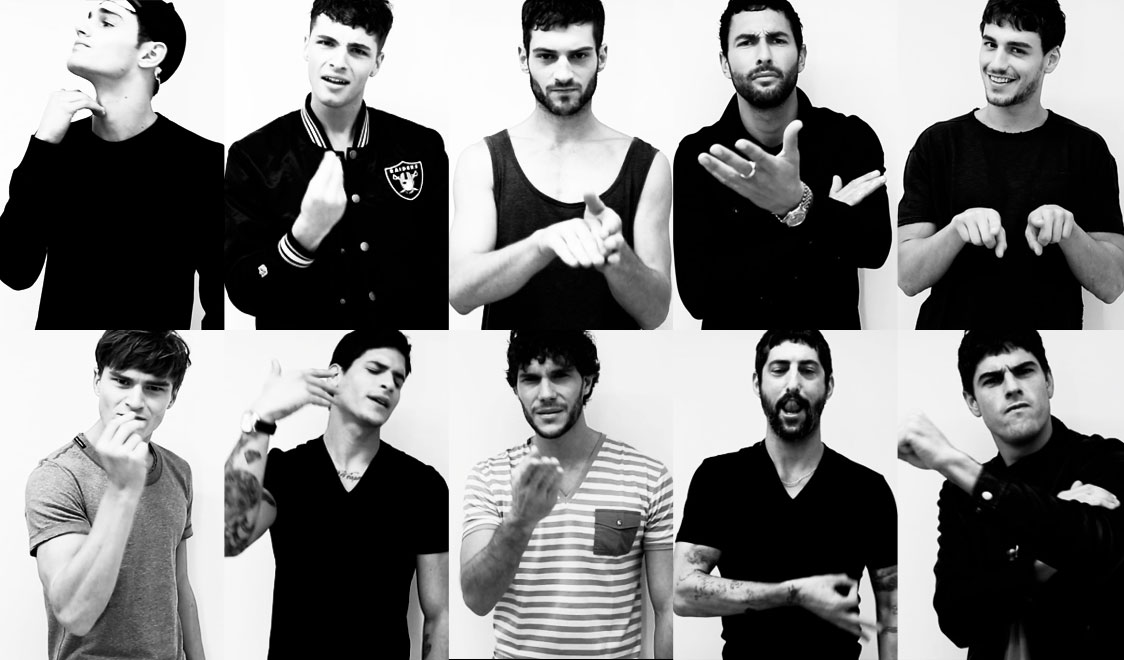
Gestures are the final common nonverbal communication. Saying something is "over there" means nothing without a gesture. However hand movements show a lot about what else is being said. As an Italian, I experience Italian hand syndrome which looks a little like this:
Essentially, it's over exaggerated hand movements that has led to me making physical contact with the people around me. I get excited, and when I speak my gestures become part of my speech. It's part of how we communicate and an important part of what makes us tick.
Nonverbal communication can shape the way you view a person or how you're viewed, so it's important to watch not only what you say, but how you say it.
I want to focus on the nonverbal aspect of communication today. Body language, facial expressions, and gestures all have a very important role to play in how we communicate with other people around us.
Body language conveys a lot about what a person is feeling, even if it's not entirely true. Look at the four women in this photo. While they are all the same woman, each position comes across as a very different emotion. This woman appears to be getting ready for an interview, and as this picture came from an article titled: 7 Body Language Mistakes May be Holding Back Your Career, I think it's safe to say that's what she's doing. The first woman looks bored out of her mind, and doesn't seem to really want the job. The second women's mind seems to be elsewhere and waiting for the weekend or dinner with friends after the interview. The third woman seems far too relaxed for an interview giving out a bad vibe for potential employers. The fourth women looks to be eager to interview, but confident enough to hold her ground. She seems very prepared with her papers in hand and a friendly, welcoming smile on her face. Out of these four women I would hire the woman on the far right because she has the right body language.
Nonverbal communication is not only important for interviews, but for everyday communication. Facial expressions, for example, show what a person is thinking/feeling at any given moment. No sound is needed for me to know that the second row far right picture is disgusted with whatever is happening in front of her. Facial expressions change the way words come across to a listener and can alter the tone of what is being said. What they say is true, "it's not what you say, but how you say it" and facial expressions are a big part of that.
Gestures are the final common nonverbal communication. Saying something is "over there" means nothing without a gesture. However hand movements show a lot about what else is being said. As an Italian, I experience Italian hand syndrome which looks a little like this:
Essentially, it's over exaggerated hand movements that has led to me making physical contact with the people around me. I get excited, and when I speak my gestures become part of my speech. It's part of how we communicate and an important part of what makes us tick.
Nonverbal communication can shape the way you view a person or how you're viewed, so it's important to watch not only what you say, but how you say it.
Monday, November 23, 2015
Maps! Maps! Maps!
Maps convey so much about the world. They have the power to shape our world view. Through maps we gain a sense of the world and where things are. Like most Americans I have a vague sense of where everything is, but I would have trouble telling you where every country on the map was in relation to other countries.
Looking at the maps above, they are both maps of the modern world (the peters map is lacking South Sudan, but the idea is there), yet they are very different. The Peters map (bottom) shows an accurate area of each country projection of the world, where as the Mercator map shows the world as countries fit together with each other. For more information and a brief history of maps: click here.
There are inherent problems with both of these types of maps.
First of all, neither map shows a true depiction of the world. The Mercator map shows where countries are in the world, communicating a warped view of what the word really looks like. The countries further away from the equator are warped to be larger than they actually are. Greenland for example looks larger than all of South America, when, in reality, it is much much smaller.
The Peters map doesn't show an accurate depiction of the world either because while all the countries have the appropriate area, the Peters map doesn't show their correct spacing in the world. All the countries are lengthened near the equator and shortened near the poles. It's just overall not a great picture of what the world is.
Maps have to power to shape our world view, and it is important to remember that flat maps are not the truth and there is going to be something warped about them. Cartographers have the responsibility to create the best possible representation of a round world on a flat surface, and that is a difficult task. It is very impressive that the earliest world maps (including the Americas) date back to the early 1500s.
Tuesday, November 17, 2015
Introvert vs. Extrovert
What does it mean to be an introvert? Dictionary.com defines it as: a person characterized by concern primarily with his or her own thoughts and feelings. Being an introvert does not mean being quiet or lacking confidence. As an extrovert with an introverted father, it was always hard to communicate and find a common ground in what we would talk about and how we would talk about it.
Our first shared interest: baseball. He would take me to Wrigley Field and we would talk about the cubs and who the best players were. Then we were able to share comedy. As I got older and was able to watch actual stand-up comedy and understand the jokes, and my dad and I gained a report and were able to talk to each other as never before.
When I was younger, I didn't know what the difference between an introvert and an extrovert was. To learn the difference click here.
Communication between an introvert and an extrovert can be difficult if both parties are not looking out for the other's interest. For an extrovert, be careful to give an introvert time to think and respond about what they are going to say because that's important to them. For an introvert, understand that an extrovert often acts or speaks before thinking and can run into a lot of problems because of that. For introverts and extroverts to communicate effectively each party needs to be forgiving and understanding.
Introvert and extroverts are nearly opposites, but it is true what they say: opposites attract. The best relationships or friendships between people I have witnessed have been between introverts and extroverts. Both need each other for the relationship to work.
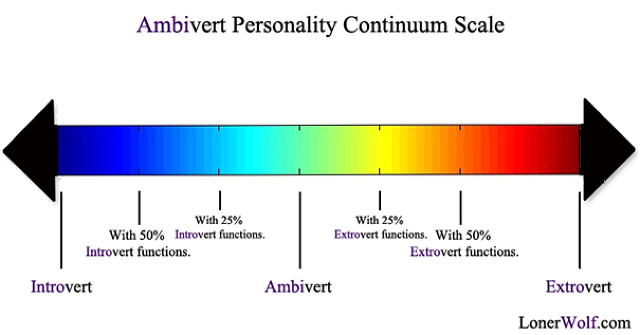
One is not better than the other, each are just very different from the other. It is also important to recognize that being an intro or extrovert isn't a dichotomy, it's a spectrum. A spectrum that would often look like the one below.
Whether you identify for as an introvert or more as an extrovert, remember that other types of people exist in the world and their perspectives matter. Communicating with them doesn't come naturally, but in the end gaining their knowledge and their perspective is worth the uncomfortably felt.
Between my father and I, we have figured out many different things we can talk about while satisfying both our needs in communication and otherwise. It has taken me seventeen years, but I'm finally able to have a long standing and healthy relationship with my father.
Our first shared interest: baseball. He would take me to Wrigley Field and we would talk about the cubs and who the best players were. Then we were able to share comedy. As I got older and was able to watch actual stand-up comedy and understand the jokes, and my dad and I gained a report and were able to talk to each other as never before.
When I was younger, I didn't know what the difference between an introvert and an extrovert was. To learn the difference click here.
Communication between an introvert and an extrovert can be difficult if both parties are not looking out for the other's interest. For an extrovert, be careful to give an introvert time to think and respond about what they are going to say because that's important to them. For an introvert, understand that an extrovert often acts or speaks before thinking and can run into a lot of problems because of that. For introverts and extroverts to communicate effectively each party needs to be forgiving and understanding.
Introvert and extroverts are nearly opposites, but it is true what they say: opposites attract. The best relationships or friendships between people I have witnessed have been between introverts and extroverts. Both need each other for the relationship to work.
One is not better than the other, each are just very different from the other. It is also important to recognize that being an intro or extrovert isn't a dichotomy, it's a spectrum. A spectrum that would often look like the one below.
Whether you identify for as an introvert or more as an extrovert, remember that other types of people exist in the world and their perspectives matter. Communicating with them doesn't come naturally, but in the end gaining their knowledge and their perspective is worth the uncomfortably felt.
Between my father and I, we have figured out many different things we can talk about while satisfying both our needs in communication and otherwise. It has taken me seventeen years, but I'm finally able to have a long standing and healthy relationship with my father.
Subscribe to:
Posts (Atom)